Proximity Bias at Work: Meaning, Examples, and Prevention
Proximity bias can affect promotions, performance reviews, and team collaboration. See its causes, examples, impact, and practical ways to prevent it.

Do the employees you see more often also receive the biggest opportunities?
That simple question reveals one of the biggest challenges in today's hybrid workplace. Proximity bias can influence promotions, recognition, project assignments, and performance evaluations without you even realizing it.
In this guide, you'll learn what proximity bias in the workplace means, why it happens, how it affects your team, and what you can do to prevent it.
What is Proximity Bias?
Proximity bias is a type of cognitive bias where you naturally give more attention, trust, or recognition to employees you interact with more often because they work closer to you. As more teams work across offices, homes, and different locations, employees who work near you can receive more visibility and opportunities than equally capable employees who work remotely.
It is important not to confuse proximity bias with cognitive bias. Cognitive bias is the broader category of mental shortcuts that influence judgment, while proximity bias is one specific type of cognitive bias. It closely relates to the mere exposure effect, which explains why repeated exposure to someone often creates a stronger preference or sense of familiarity.
As more teams adopt hybrid and remote work, recognizing proximity bias becomes essential for making fair, consistent, and objective decisions. When you evaluate employees based on measurable outcomes instead of physical presence, you create equal opportunities for everyone, regardless of where they work.

Did You Know
According to a study by Executive Networks, 71% of senior HR leaders and 62% of senior business leaders agree that employees who work in the office are more likely to gain advantages because of proximity bias.
What is the Impact of Proximity Bias?
Proximity bias affects far more than performance reviews. It compounds across morale, career growth, team trust, and retention, and by the time you notice the pattern, you've usually already lost good people to it. Here's where the damage actually shows up.
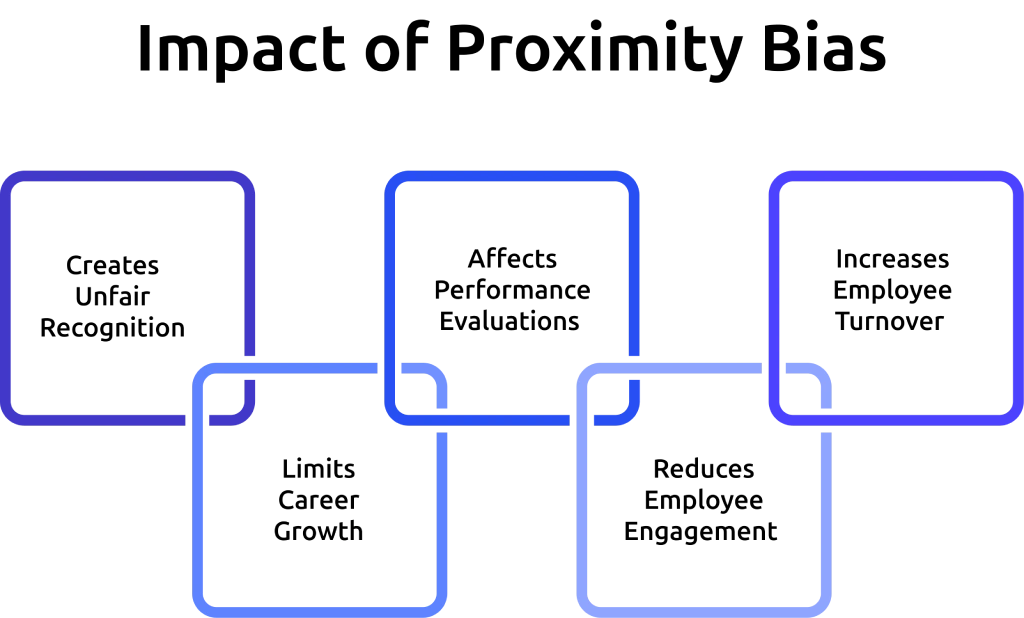
1. Creates Unfair Recognition
Employees who work closer to you naturally have more opportunities for conversations, updates, and face-to-face interactions. As a result, their contributions can stay fresh in your mind, while equally valuable work from remote employees may receive less recognition.
Over time, this creates an uneven experience where visibility influences appreciation more than actual results. That imbalance can reduce trust and make recognition feel inconsistent.
2. Limits Career Growth
Career growth depends on more than completing daily tasks. It also depends on receiving meaningful projects, mentorship, and opportunities to demonstrate skills.
When the same employees receive those opportunities simply because they remain more visible, other capable team members may struggle to progress even though they consistently deliver strong results.
3. Affects Performance Evaluations
Performance reviews should reflect achievements, measurable outcomes, and overall contribution. However, frequent in-person interactions can sometimes influence how you remember recent work and accomplishments.
As a result, remote employees may receive less recognition for their work, and evaluations may depend more on visibility than actual results.
4. Reduces Employee Engagement
When employees feel their work goes unnoticed, they gradually lose motivation to contribute beyond their assigned responsibilities. Even high performers may hesitate to share ideas or volunteer for additional work if they believe visibility matters more than effort.
5. Increases Employee Turnover
Employees want to grow in a workplace where contributions matter more than physical presence. If they repeatedly experience fewer opportunities despite delivering quality work, they may start looking for a workplace that offers a fairer path for growth.
Finding it difficult to evaluate employee performance fairly?
Try Time Champ to measure your team's performance based on actual work.
What Are Common Examples of Proximity Bias?
This bias can appear in many everyday workplace situations without anyone realizing it. It can influence decisions in subtle ways and create unequal opportunities across your team. Here are some common examples that show how it affects day-to-day work.
1. High-Visibility Projects Go to the Same Employees
When an important project comes up, you may naturally think of employees you interact with most often. As a result, equally skilled remote employees can miss valuable opportunities to demonstrate their abilities and take on bigger responsibilities.
2. Faster Feedback for In-Office Employees
In-office employees can easily ask questions and receive immediate feedback throughout the day. Employees working from home or other locations may have fewer opportunities for these conversations, making feedback less frequent and less timely. As a result, they may take longer to resolve issues, improve their work, and build the skills needed for future opportunities.
3. Mentorship and Networking
Hallway chats, lunch invites, and casual introductions help build relationships that support career growth. In-office employees naturally become part of these interactions, while those working from other locations. Because they may miss them unless you make a deliberate effort to include everyone. Over time, this can reduce access to mentorship, valuable guidance, and professional connections.
4. Promotion Decisions
This is where proximity bias does the most damage. Remote workers are 24% less likely to receive promotions compared to in-office colleagues, according to a ResumeBuilder survey of over 1,100 full-time employees. Even with strong performance, employees working remotely can miss promotion opportunities because employees who are more visible tend to receive more attention.
How Can You Prevent Proximity Bias in the Workplace?
Creating a fair workplace requires more than offering flexible work options. You need consistent processes that give every employee equal opportunities, regardless of where they work. Here are some practical ways to reduce bias and make better workplace decisions.
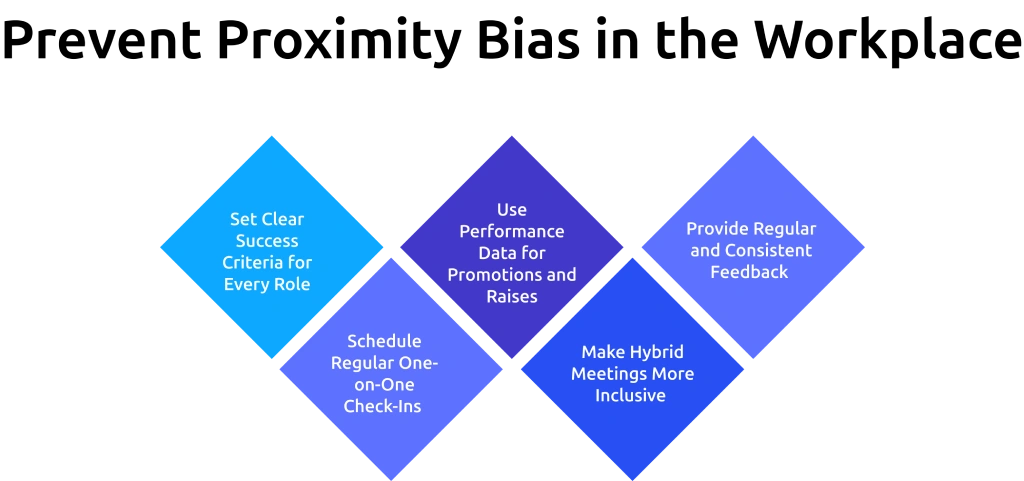
1. Set Clear Success Criteria for Every Role
Before you can judge anyone's performance fairly, you need a clear definition of what success looks like for each role. Clearly define the deliverables, quality standards, and outcomes for every role. Once you document the criteria, you stop relying on impressions like "always at their desk" or "seems engaged" and start comparing actual results. This simple step removes much of the guesswork that allows bias to influence performance reviews.
2. Schedule Regular One-on-One Check-Ins
Employees working in the office naturally build relationships through hallway conversations and quick check-ins. Employees working remotely only get these opportunities when you create them intentionally. Schedule weekly or biweekly one-on-one meetings for everyone using the same format and duration, regardless of where they work.
You can also have occasional informal conversations without a fixed agenda to stay connected. Avoid canceling or skipping these meetings, even when there are no urgent topics to discuss. Regular conversations help build trust and ensure every employee receives equal support.
3. Use Performance Data for Promotions and Raises
Make promotion and bonus decisions based on documented performance instead of visibility or personal impressions. Before making a decision, review each employee's work from the past few months and compare it with the success criteria for their role. This helps you make fair decisions based on actual results and reduces the chances of overlooking employees who consistently perform well, regardless of where they work.
4. Make Hybrid Meetings More Inclusive
Hybrid meetings can easily favor employees who are in the office. If even one employee joins remotely, ask everyone to join the meeting from their own device so everyone has the same experience.
Give different team members the opportunity to lead meetings, document important decisions after every meeting, and record sessions for employees in different time zones. These simple changes help every employee participate equally and ensure that every employee gets the opportunity to contribute.
5. Provide Regular and Consistent Feedback
Employees working in the office often receive quick feedback during everyday conversations. Employees working remotely need a more structured approach to receive the same level of guidance. Schedule regular written feedback, monthly one-on-one discussions, and a review after every project. Also, ask employees whether they have enough guidance and support, as they may not always bring up these concerns on their own. This helps everyone receive the feedback they need to improve and grow.
How Time Champ Helps Eliminate Proximity Bias
Making fair decisions in employee performance evaluation becomes easier when you have a clear view of every employee's work, no matter where they work. Time Champ is an employee monitoring and time tracking software that helps you evaluate performance using real work data instead of visibility alone. It provides clear insights into daily work, projects, and productivity, making performance reviews more consistent and fair across your team. Here are some of the features that help reduce bias and support objective decision-making.
- Employee Productivity Tracking Track productive hours, non-productive hours, idle time, focus time, and overall work patterns across your team. This helps you evaluate performance using actual work instead of how often you see someone in the office.
- Automatic Time Tracking: Capture work hours automatically without relying on manual timesheets. Accurate time records give you a clearer picture of each employee's daily work and make performance reviews more reliable.
- Project and Task Tracking: Monitor project progress, task completion, deadlines, and workloads in one place. This makes it easier to recognize contributions based on completed work rather than physical presence.
- Performance Reports and Analytics: Generate detailed reports that show productivity trends, work hours, project progress, attendance, and team performance. These insights support fair decisions for promotions, rewards, and performance reviews.
- Employee Monitoring: View application usage, website activity, screenshots, and work timelines to understand daily work patterns. This gives you objective information instead of relying on assumptions or visibility.
- Attendance Management: Track attendance, working hours, breaks, and leave records automatically. Having consistent attendance data helps you evaluate every employee using the same standards.
Struggling to evaluate remote and in-office employees fairly?
Try Time Champ to compare performance using accurate work data, not assumptions.
Conclusion
Proximity bias can quietly influence everyday workplace decisions, but it doesn't have to become part of your workplace culture. Setting clear expectations, using consistent evaluation methods, and giving every employee equal access to opportunities help create a fairer environment where performance matters more than visibility. If you want to support these decisions with accurate work data, Time Champ gives you the insights needed to evaluate employees based on their actual contributions, making performance reviews, promotions, and recognition more objective and consistent.

Thasleem Shaik

Table of Content
 What is Proximity Bias?
- What is the Impact of Proximity Bias?
- What Are Common Examples of Proximity Bias?
- How Can You Prevent Proximity Bias in the Workplace?
- How Time Champ Helps Eliminate Proximity Bias
- Conclusion
Related Blogs
Avoid common remote team management mistakes that hurt productivity. Learn how to handle communication, collaboration, and efficiency challenges effectively.
Jahnavi Pulluri | Mar 15, 2025
Productivity Tracking Software helps remote teams stay on top, track progress, streamline workflows & boost efficiency effortlessly. Learn more!
Shabana Shaik | Mar 15, 2025
Why remote work is becoming more popular in the last few years? Check out our 4 reasons companies are using remote work.
Shabana Shaik | Mar 14, 2025
Wondering why meetings are essential in remote work? Uncover 10 key reasons they improve communication, teamwork, and efficiency for your remote team!
Tarun Kumar Reddy | Mar 14, 2025
Struggling to keep your remote team connected? Explore 10 proven strategies to boost engagement, strengthen teamwork, and build a thriving remote culture!
Tarun Kumar Reddy | Mar 14, 2025
Struggling to improve your remote workplace? Uncover six powerful strategies to boost productivity, enhance collaboration, and keep your team engaged!
Tarun Kumar Reddy | Mar 14, 2025


 4.7/5 avg.
Ready to Manage Your Workforce Smarter?
Join our family of 1500+ companies using smart insights to redefine workforces!

Free Trial
No Credit Card Required